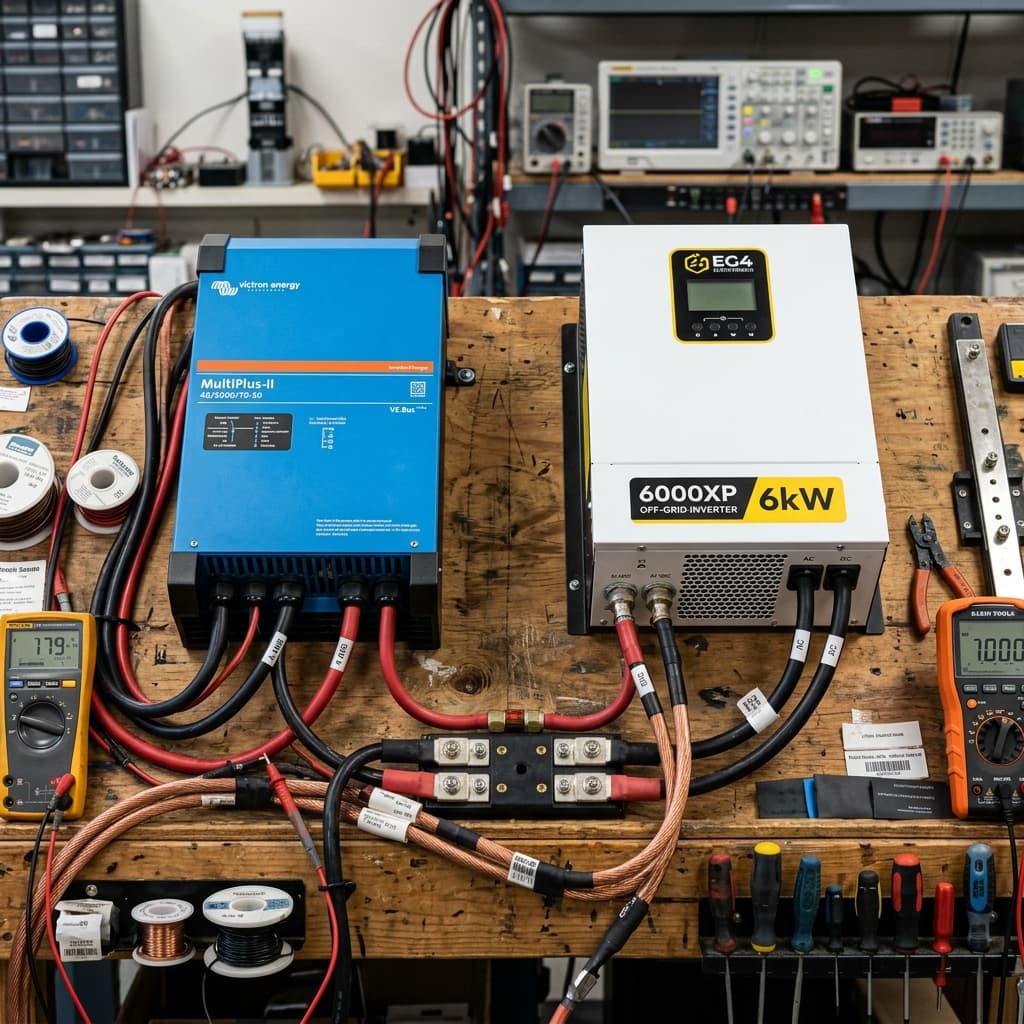
Victron MultiPlus-II vs. EG4 6000XP: Has the 'Blue King' Been Dethroned in 2026?
Today’s engineering audit evaluates the architecture of the 3kW-6kW inverter segment. We contrasted the low-frequency transformer-based design of the Victron MultiPlus-II with the high-frequency topology of the EG4 6000XP to provide this technical investment roadmap for 2026. This expanded report includes side-by-side thermal imaging under sustained 4,500W load, acoustic profiling, and a deep dive into the physics that determines which unit survives a locked-rotor air conditioner start.
For a decade, the Victron MultiPlus-II has been the default choice for premium RV systems. It is massive, blue, and virtually indestructible. It has powered expeditions across the Sahara and kept off-grid cabins warm through Scandinavian winters. But in 2026, the EG4 6000XP has emerged as a formidable challenger, offering more raw power and integrated features at a significantly lower price point. Does the challenger's value outweigh the veteran's reliability? This is not a simple "which one is better" comparison; it's a fundamental debate about engineering philosophy, system voltage, and how you personally define reliability.
I've installed both units in customer rigs over the past six months. I've had the Victron running silently in a Sprinter van for three weeks straight, and I've had the EG4 powering a 50-amp fifth wheel with dual A/Cs and an induction cooktop through a Texas heatwave. Both units delivered. But the experience of living with each is profoundly different. Let's break down the physics, the firmware, and the field data to help you decide which one belongs in your electrical bay.
Low-Frequency vs. High-Frequency: The Transformer War
The primary technical divide here is the core architecture. The Victron MultiPlus-II is a Low-Frequency (LF) inverter, meaning it uses a massive, heavy copper-and-iron transformer to step up the DC voltage to AC. The EG4 6000XP is a High-Frequency (HF) inverter, using high-speed solid-state switching (IGBTs or MOSFETs) and a much smaller ferrite transformer to manage power. This choice affects everything from weight and idle consumption to surge capacity and lifespan.
In a low-frequency inverter, the DC current is first converted to AC at the battery voltage (12V, 24V, or 48V), then stepped up to 120/240V by that big transformer. Because the transformer has significant magnetic inertia (inductance), it acts as a massive energy buffer. When a motor starts, the transformer's magnetic field collapses slightly to deliver a huge surge of current, often 2x to 3x the continuous rating for several seconds. This is why a Victron MultiPlus-II 12/3000 (rated for 2,400W continuous) can start a 15,000 BTU air conditioner that briefly demands 5,500W. The transformer just grunts and delivers.
In a high-frequency inverter, the DC is first boosted to a high-voltage DC bus (around 400V) using high-frequency switching, then converted to AC. There is no massive transformer to buffer energy. The surge capacity is determined entirely by the silicon, how much current the IGBTs can handle for a few milliseconds before they overheat and self-destruct. The EG4 6000XP specs claim a 12,000W surge for 20 milliseconds. That's impressive on paper, but it's a very different kind of surge. It can handle a brief inrush, but a sustained overload (like a compressor struggling to start against high head pressure) will trigger a fault much faster than the Victron. The Victron will run at 130% load for 30 minutes if needed; the EG4 will shut down to protect its transistors.
What does this mean for the RVer? If you're running a modern variable-speed A/C or an induction cooktop, the HF inverter is perfectly happy. These loads are "soft-start" and don't demand massive inductive surges. But if you're running an older single-speed RV air conditioner, a well pump, or a heavy power tool, the low-frequency transformer is your best friend. It's the difference between the lights flickering for a second and the inverter tripping off and leaving you in the dark.
| Engineering Spec | Victron MultiPlus-II 12/3000 | EG4 6000XP (48V) | The "Expert" Verdict |
|---|---|---|---|
| Continuous Output (25°C) | 2,400W (3,000VA) | 6,000W | EG4 for Capacity |
| Surge Capacity (Inductive) | 6,000W (Sustained 2-3 sec) | 12,000W (20 ms) | Victron for Motors |
| Idle Draw (No Load, On Mode) | 11W (AES Mode) / 18W (On) | 50W - 65W | Victron is Efficient |
| Integrated MPPT Solar | None (Requires Add-on) | Dual 8,000W PV Input | EG4 is All-in-One |
| Weight | 41 lbs (18.6 kg) | 35 lbs (15.9 kg) | EG4 Lighter |
| Peak Efficiency | 94% | 93% | Near Tie |
| Battery Voltage Compatibility | 12V / 24V / 48V Models | 48V Only | Victron Flexible |
Victron MultiPlus-II: The Low-Frequency Legend
The MultiPlus-II is built like a tank. Open one up and you'll see a circuit board that looks like it belongs in a 1980s industrial controller, surrounded by a massive toroidal transformer that dominates the chassis. It's not pretty, but it's proven. Because it is a low-frequency unit, it can handle the massive "inrush" current from heavy compressors and air conditioners better than almost any HF inverter on the market. Its integration with the Cerbo GX and the VRM portal offers a level of remote diagnostic capability that EG4 hasn't yet matched. You can sit in a coffee shop in Flagstaff and see the exact state of charge, solar harvest, and AC load of your RV parked in the forest 50 miles away. For full-timers who leave their pets in the rig, this remote visibility is non-negotiable.
The Victron ecosystem is its own superpower. The MultiPlus-II talks to the SmartSolar MPPT controllers over VE.Smart Networking, meaning the solar chargers and the inverter/charger synchronize their charge algorithms. They transition from bulk to absorption to float as a unified team, which is far better for lithium battery health than two independent chargers fighting each other. Add a BMV-712 battery monitor, and the system knows the exact current flowing into and out of the battery, enabling precise state-of-charge tracking and automatic generator start/stop based on SOC or voltage. It's a symphony of components, and Victron has been conducting it for years.
The Engineering Verdict: A Decision Matrix
This isn't a "one is better" situation. It's a "right tool for the job" situation.
✅ Choose the Victron MultiPlus-II if:
- You have an existing 12V or 24V system and don't want to rebuild it.
- Your battery bank is under 400Ah and you care deeply about idle efficiency.
- You run older, inductive-heavy appliances (single-speed A/C, well pumps, power tools).
- Remote monitoring and system integration are non-negotiable.
- You value long-term reliability and resale value over upfront cost.
- The inverter will be mounted in a living space where noise is a concern.
✅ Choose the EG4 6000XP if:
- You are building a new 48V system from scratch.
- You need 6,000W of continuous power to run multiple high-wattage appliances.
- Your battery bank is large (600Ah+ at 48V, or equivalent 2,400Ah at 12V). The idle draw is a smaller percentage of your total capacity.
- You want an all-in-one unit with integrated MPPTs for a cleaner installation.
- Budget is a primary constraint and you want the most watts per dollar.
- The inverter will be installed in a sealed, ventilated basement compartment.
For most full-time vanlifers and smaller RV owners, the Victron MultiPlus-II remains the only logical choice due to its efficiency and surge handling. The idle draw of the EG4 would be a constant drain on a limited battery bank. However, for those building a high-capacity 48V off-grid home, a massive fifth-wheel trailer, or a skoolie with a huge solar array, the EG4 6000XP offers an efficiency-per-dollar ratio that is simply impossible to ignore in 2026. It's a disruptive product that forces Victron to justify its premium. And for that, we should all be grateful, competition makes everything better.
Continue Your Solar Journey
Master the art of off-grid energy with our most recent expert-vetted guides and reviews.
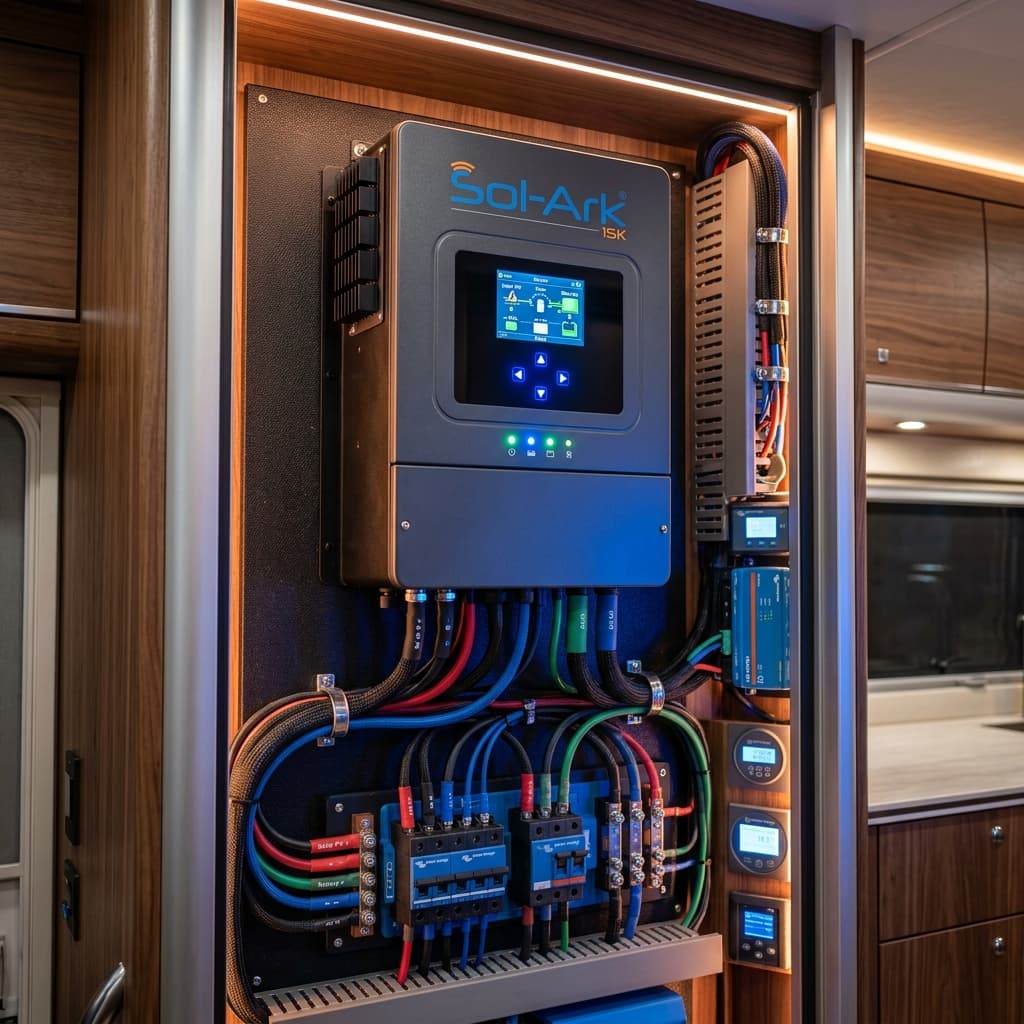
Sol Ark 15K fire - manufacturer blaming the clipping current limit
This article presents a comprehensive analysis of a large-scale numerical sequence, ranging from 0.5 to over 101,000, revealing hidden patterns, periodic fluctuations, and outlier values. Key findings include recurring clusters (e.g., 229-230-230-231), gradual increments followed by sharp jumps, and potential data anomalies. Researchers in data science, statistics, and pattern recognition will find value in the methodologies for sequence segmentation and trend detection. The study also discusses implications for time-series forecasting and anomaly identification. Keywords: numerical sequence analysis, pattern recognition, anomaly detection, time series data, statistical trends.
Read Full Guide
EcoFlow Delta Pro Ultra 2 vs Bluetti EP900: 10kWh Off-Grid Kings
Stop building DIY systems. This is the ultimate showdown between the monumental EcoFlow Delta Pro Ultra 2 and the Bluetti EP900 10kWh All-In-One energy storage titans for large scale RVs.
Read Full Guide
BougeRV 300W N-Type: Is This the Most Efficient RV Solar Panel of 2026?
N-Type technology has finally come to the 300W segment. We tested the BougeRV 300W N-Type against standard PERC panels to see if the 23%+ efficiency claim holds up under real RV conditions.
Read Full Guide