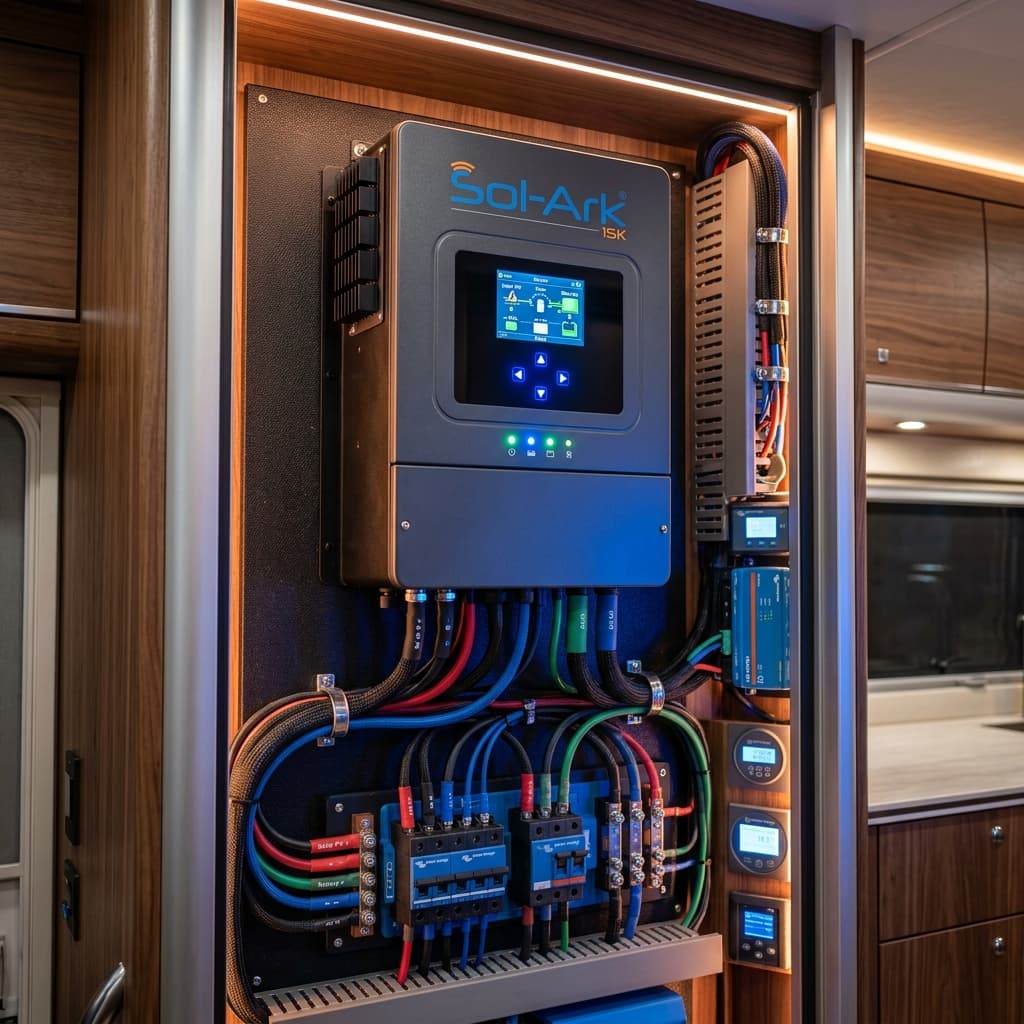
Sol Ark 15K fire - manufacturer blaming the clipping current limit
A catastrophic failure in a large-scale grid-tied inverter, where the manufacturer attributed the cause to a current clipping limit, raises critical questions about the design, safety protocols, and durability of the photovoltaic hardware we rely on in our recreational vehicles. This technical analysis unravels the lessons for the mobile off-grid world.
The off-grid community was shaken by reports of a fire-related incident involving a Sol Ark 15K hybrid inverter. The subsequent investigation, where the manufacturer pointed to the clipping current limit as a contributing factor, is not just an issue for residential installations. It is a wake-up call for everyone who depends on compact, high-power-density solar systems in demanding environments: camper vans, motorhomes, and RVs. This article provides an in-depth technical review, using that case as a starting point to evaluate the engineering, safety, and longevity of modern inverters and charge controllers for mobile applications. Beyond the datasheet specifications, we examine how poorly implemented operational limits can compromise durability and, more importantly, onboard safety.
Technical Analysis: From Clipping to Catastrophic Failure
So-called "clipping" occurs when an inverter or charge controller intentionally limits its output power to protect itself from input spikes that exceed its rated capacity. It is a common design practice. However, the key lies in how that excess energy is managed. Dissipating it as heat inefficiently or within a confined space is a recipe for disaster, especially in the tight, poorly ventilated compartment of a motorhome.
Critical Specifications You Must Understand
For an RV user, beyond watts and volts, these are the specifications that define the robustness and safety of an inverter or MPPT controller:
| Technical Parameter | Description | Implication for RV / Motorhome | Reference Value (High-End) |
|---|---|---|---|
| MPPT Voltage Range | The voltage limits within which the controller can track the maximum power point. | A wide range allows connecting more panels in series, optimizing wiring on long roofs. | 120-450 Vdc |
| Maximum Input Current | Maximum current the PV terminals can safely and continuously accept. | Exceeding it, even on cold, sunny days, can cause terminal and fuse overheating. | Up to 100A (depending on model) |
| Peak Efficiency (Euro/ETA) | Maximum percentage of energy usefully converted. Losses are dissipated as heat. | Every percentage point lost is extra heat in an already warm electrical cabinet. Target >97%. | 98.6% |
| Thermal Dissipation Design | Method for evacuating heat: passive heatsinks, forced ventilation, etc. | Fans add failure points and noise. Large passive heatsinks require space and airflow. | Large surface area extruded aluminum passive heatsink. |
| Clipping Protection | Mechanism to handle excess panel power (disconnection, active limiting). | A poorly designed system can create local hot spots and prematurely degrade components. | Electronic limiting with temperature monitoring at critical points. |
Comparison of Inverters and Controllers for the RV Environment
We take three representative market categories to evaluate how they address the balance between power, safety, and thermal management.
All-in-One Hybrid Inverter-Charger
PROS
- Seamless integration: inverter, battery charger, and transfer switch in one unit.
- Intelligent management of power sources (solar, grid, generator).
- Unified user interface and centralized programming.
- Highly efficient energy flow between components.
CONS
- Single point of failure: One problem can take the entire system offline.
- Greater thermal challenge: Multiple heat sources in the same enclosure.
- Aggressive forced ventilation that can suck in dust and create noise.
- Less flexibility for upgrades or modular repairs.
Analogous Example: Victron MultiPlus-II or similar.
High-Current MPPT Controller + Standalone Inverter
PROS
- Separation of functions: heat is generated in physically separate components.
- Greater redundancy: a failure does not necessarily collapse the whole system.
- You can optimize each component separately (e.g., MPPT for specific panels).
- Better thermal dissipation by distributing the heat load.
CONS
- More complex installation with more wiring and connection points.
- Requires an integrated monitoring and communication system (e.g., via CAN bus).
- Can be more expensive overall and take up more space.
- Coordinating protections between independent devices is critical.
Analogous Example: Victron SmartSolar MPPT + Victron Phoenix Inverter, or cross-brand combinations.
"Lithium All-in-One" System (with Integrated BMS)
PROS
- Deep integration with battery chemistry, optimizing charging and discharging.
- Native communication between BMS, MPPT, and inverter for maximum battery safety.
- Greatly simplified user interface oriented towards "set and forget".
- Compact design that saves space.
CONS
- Vendor lock-in: Ties you to a specific battery and charger ecosystem.
- Expansion or repair capability outside the brand may be nonexistent.
- Power and heat density within a small enclosure can be extreme.
- The replacement cost of a complete unit is high.
Analogous Example: Integrated systems from brands like REDARC, Renogy, or specific vanlife solutions.
Durability Verdict: Decisive Factors Beyond the Warranty
A 5-year warranty means nothing if the equipment fails in the Atacama Desert or a Nordic winter. Durability is built through design and component choices.
Accelerated Stress Factors in the RV Environment
- Vibrations and Shocks: Constant movement loosens terminals and fatigues solder joints. Look for equipment with locked connectors, PCB boards secured with anti-vibration mounts, and automotive-grade (vibration-resistant) electrolytic components.
- Extreme Thermal Cycles: From -10°C at night to +45°C in the electrical compartment under the sun. This expands and contracts materials, generating mechanical stress. Solid aluminum heatsinks and solid polymer capacitors (instead of electrolytic) are superior.
- Humidity and Condensation: Daily breathing inside a vehicle generates moisture. An IP21 or higher protection rating is desirable. Conformal-coated circuit boards resist corrosion better.
- Dust and Dirt: Cooling fans are vacuum cleaners for dust. Passively cooled designs, although larger, are inherently more robust in the long term.
- Operational Oversizing: An inverter always working at 80-90% of its rated capacity will have a shorter lifespan than one operating at 50-60%. Conclusion: Invest in equipment with a generous power margin (+30-50%).
Lesson from the Incident: Thermal Management is Key
The Sol Ark 15K case underscores that "clipping" is not bad per se, but its implementation can be. An RV inverter must:
- Monitor temperature at multiple critical points (not just one general sensor).
- Have a progressive and smooth power derating curve with temperature, not a sharp cut-off.
- Dissipate heat from power components (MOSFETs, inductors) directly to the main heatsink with high-quality thermal paste, avoiding local hot spots.
- Include redundant protections (thermal, current, voltage) that act independently of the main firmware.
2026 Perspective: The Technological Horizon for Mobile Off-Grid
Today's lessons shape tomorrow's hardware. These three emerging technologies promise to directly address the exposed pain points.
1. Gallium Nitride (GaN) Transistors in Inverters
Traditional silicon semiconductors are reaching their limits. GaN operates at much higher switching frequencies with significantly lower losses.
Positive Impact
- Smaller and lighter inverters: Allows reducing the size of transformers and filters.
- Efficiency >99%: Drastically reduces residual heat to dissipate, mitigating the main failure risk.
- Higher heat tolerance: GaN devices can safely operate at higher temperatures.
Remaining Challenges
- Cost: Still higher than silicon, though rapidly falling.
- Robustness in harsh environments: Sensitivity to transient overvoltages (voltage spikes). Requires more sophisticated protection circuits.
- Limited availability in specific high-power RV products.
2. Sodium-Ion (Na-Ion) Batteries
Beyond lithium, sodium offers a more abundant, safer chemistry that tolerates extreme temperatures.
Positive Impact
- Superior thermal stability: Lower risk of thermal runaway than already safe LiFePO4.
- Efficient cold-weather operation: Minimal capacity loss at -20°C, a critical weak point of lithium.
- Longer cycle life: Potential to exceed 5000 cycles with minimal degradation.
Remaining Challenges
- Lower energy density: Will take up more space/weight for the same capacity (kWh) as LiFePO4. In an RV, space is paramount.
- Different charge/discharge curves: Will require MPPT controllers and inverters with specific algorithms optimized for Na-Ion.
- Market maturity and availability of formats (e.g., standard 12V/24V for RVs).
3. Perovskite-Silicon Tandem Panels
The next revolution in solar generation. Thin layers of perovskite on top of traditional crystalline silicon.
Positive Impact
- Efficiency >30%: Nearly double that of current RV panels. Generate the same power in half the roof space.
- Better performance in diffuse light and heat: Produces more energy in non-ideal conditions (mornings, evenings, cloudy days).
- Potential weight and flexibility: Could enable ultra-lightweight, curved panels for integrating into complex van surfaces.
Remaining Challenges
- Long-term durability: Degradation from moisture, UV, and heat is the biggest hurdle. They must demonstrate a 10+ year outdoor lifespan.
- Output power stability: Clipping will be an even greater challenge, as they will deliver very high power peaks in short time, demanding more from MPPT controllers.
- Manufacturing scale and cost.
Conclusion: Choose with Technical Wisdom
The Sol Ark 15K incident teaches us that in an off-grid system, every component is a link in a safety chain. For the modern nomad, the choice of an inverter or controller should not be based solely on price or rated power. It must be an exercise in defensive engineering. Prioritize equipment with an oversized and passive thermal design, redundant electrical protections, and robust mechanical construction to withstand the punishment of the road. The future, with GaN, sodium, and perovskite, will bring revolutionary efficiency and capabilities, but the fundamental principles of safety, heat management, and build quality will remain the true foundation of a durable and reliable RV solar installation. Don't just buy an inverter; invest in a robust guardian for your free energy.
Continue Your Solar Journey
Master the art of off-grid energy with our most recent expert-vetted guides and reviews.
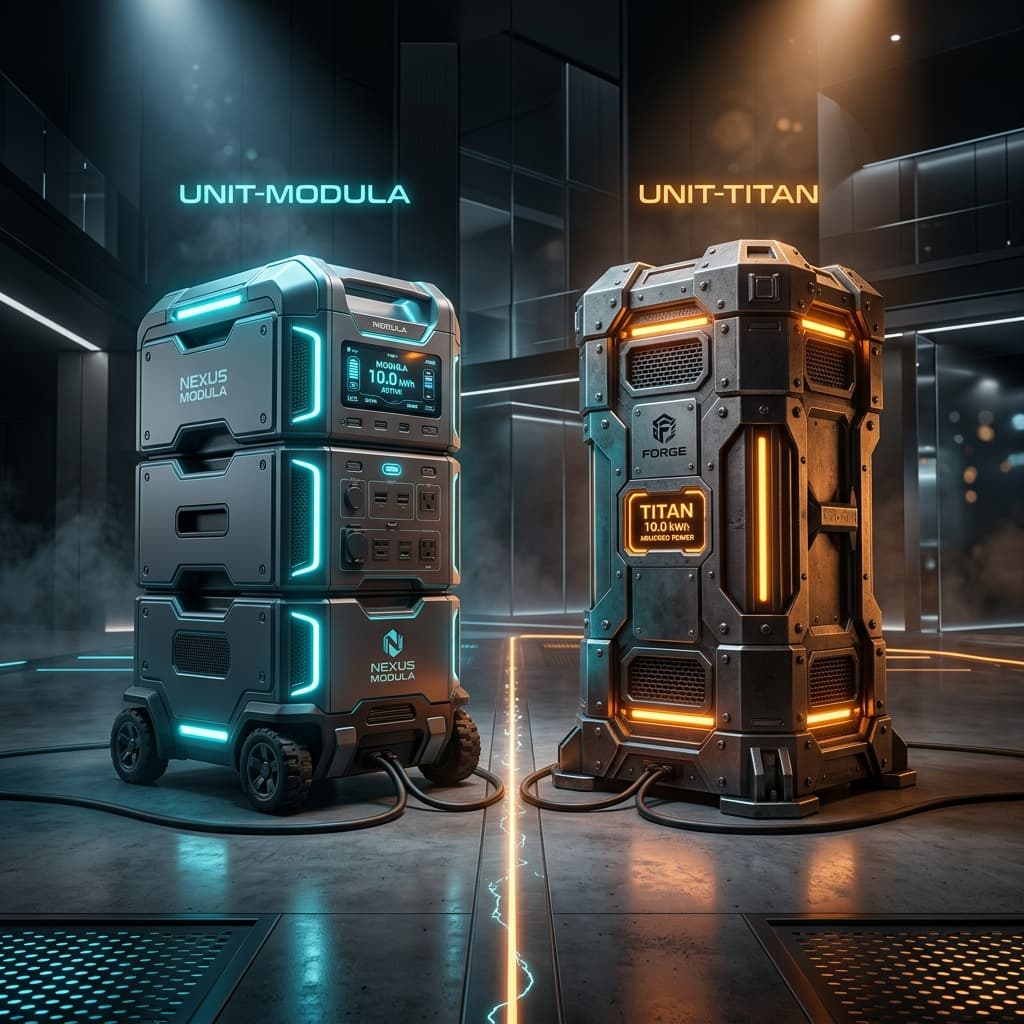
EcoFlow Delta Pro Ultra 2 vs Bluetti EP900: 10kWh Off-Grid Kings
Stop building DIY systems. This is the ultimate showdown between the monumental EcoFlow Delta Pro Ultra 2 and the Bluetti EP900 10kWh All-In-One energy storage titans for large scale RVs.
Read Full Guide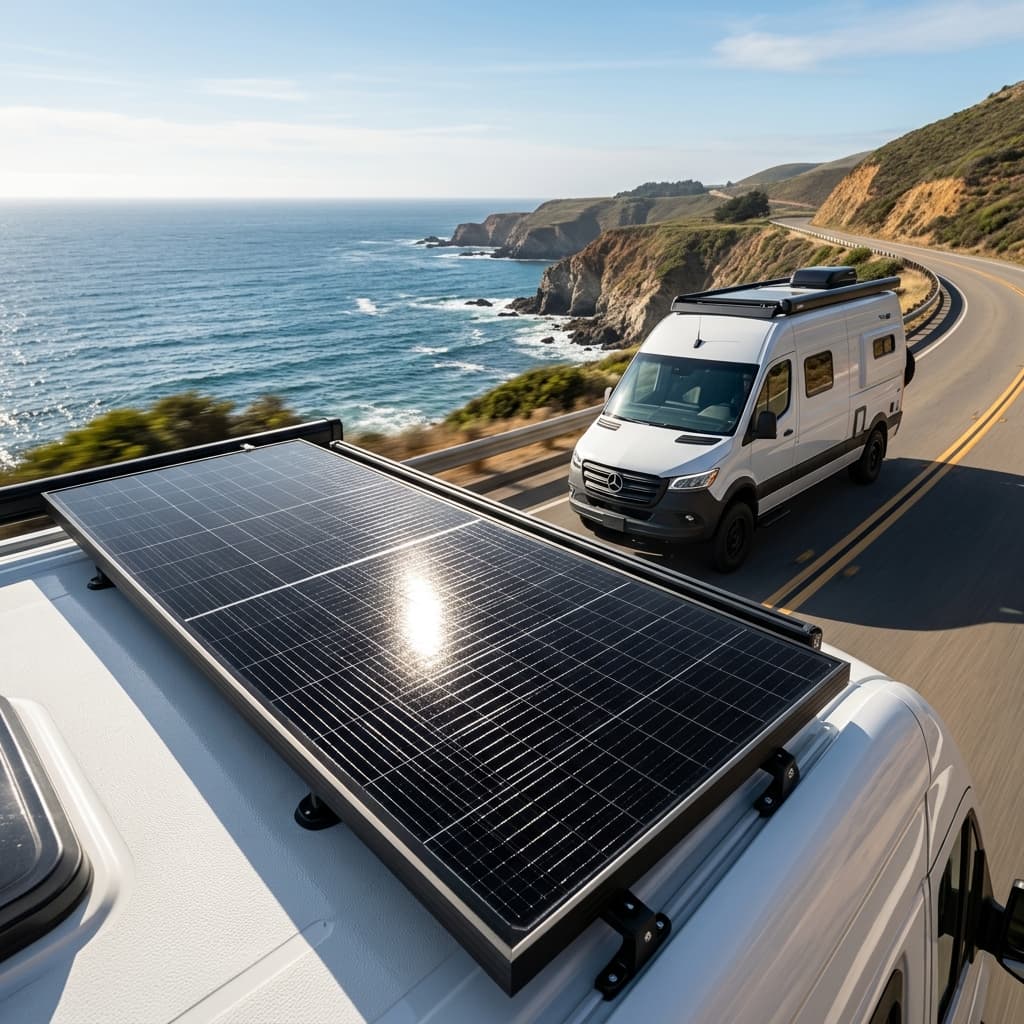
BougeRV 300W N-Type: Is This the Most Efficient RV Solar Panel of 2026?
N-Type technology has finally come to the 300W segment. We tested the BougeRV 300W N-Type against standard PERC panels to see if the 23%+ efficiency claim holds up under real RV conditions.
Read Full Guide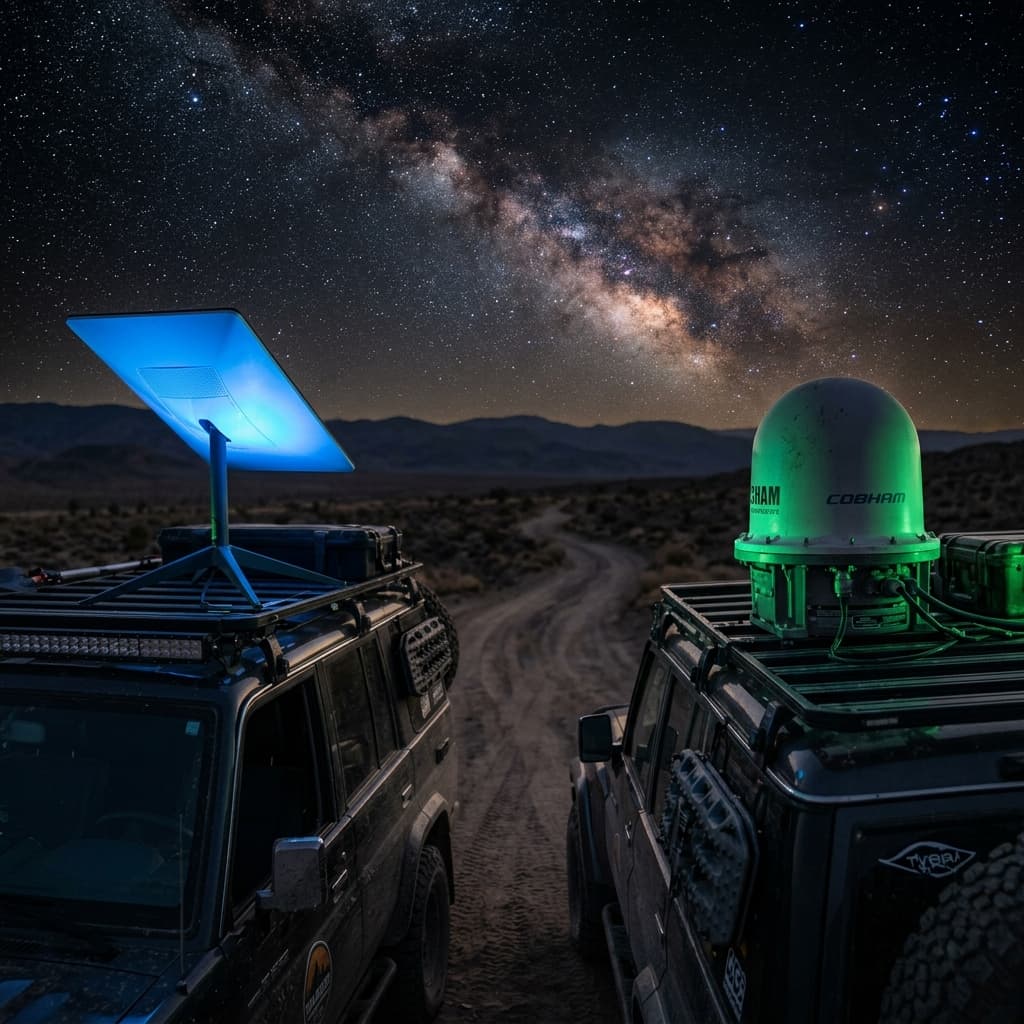
Starlink Mobile Gen 3 vs SAT-COM Low Energy: Which RV Internet is Better?
Bandwidth vs. Battery Life. We pit the notoriously power-hungry Starlink Mobile Gen 3 (V3) against emerging Low-Energy SAT-COM alternatives for the ultimate off-grid connectivity review.
Read Full Guide