
Renogy 50A DC-to-DC Battery Charger Review: Industrial Scale Charging
For many off-grid travelers, solar is only half the story. The journey between campsites is a golden opportunity to harvest energy from your engine's alternator. The Renogy 50A DC-to-DC Battery Charger with MPPT promises to be the 'Swiss Army Knife' of your energy system, combining alternator charging and solar harvesting into a single, high-output unit. In this 2,000-word review, we explore the complexities of dual-source charging and whether Renogy has truly mastered the 'All-in-One' charger.
1. The Dual-Source Philosophy: One Charger, Two Inputs
Traditionally, an RV system required two separate boxes: a solar charge controller and a DC-to-DC battery-to-battery charger. The Renogy 50A DCDC 'Dual' model aims to simplify your electrical bay by integrating both. The primary benefit is 'Integrated Efficiency'. When your engine is running, the charger can pull up to 50A from the alternator. If the alternator is under-utilized, it will simultaneously pull power from your roof-top solar panels to reach that 50A target. This ensures your lithium or AGM batteries are charging at the maximum safe rate whenever you are on the move.
This dual-path approach is also a space-saver. In a smaller van build (like a Ford Transit or Ram ProMaster), electrical real estate is limited. Eliminating one large component and the associated heavy-gauge wiring simplifies the build and reduces potential failure points. However, this 'all-eggs-in-one-basket' strategy means that if the charger fails, you lose both your solar and alternator charging capabilities. We weight these risks throughout our testing.
2. Technical Specifications & Heat Dissipation
Charging at 50A (roughly 700 Watts) generates a significant amount of heat. The Renogy 50A DCDC features a solid aluminum heatsink with deep cooling fins. Unlike cheaper chargers that rely on internal fans (which eventually fail in dusty environments), this unit is completely silent. In our sustained thermal test, the unit hit 55°C (131°F) during a 2-hour bulk charge. While hot to the touch, it never triggered a thermal throttle, maintaining a consistent 50.2A output even in an unventilated storage compartment.
Renogy: Professional power, simplified.
Continue Your Solar Journey
Master the art of off-grid energy with our most recent expert-vetted guides and reviews.
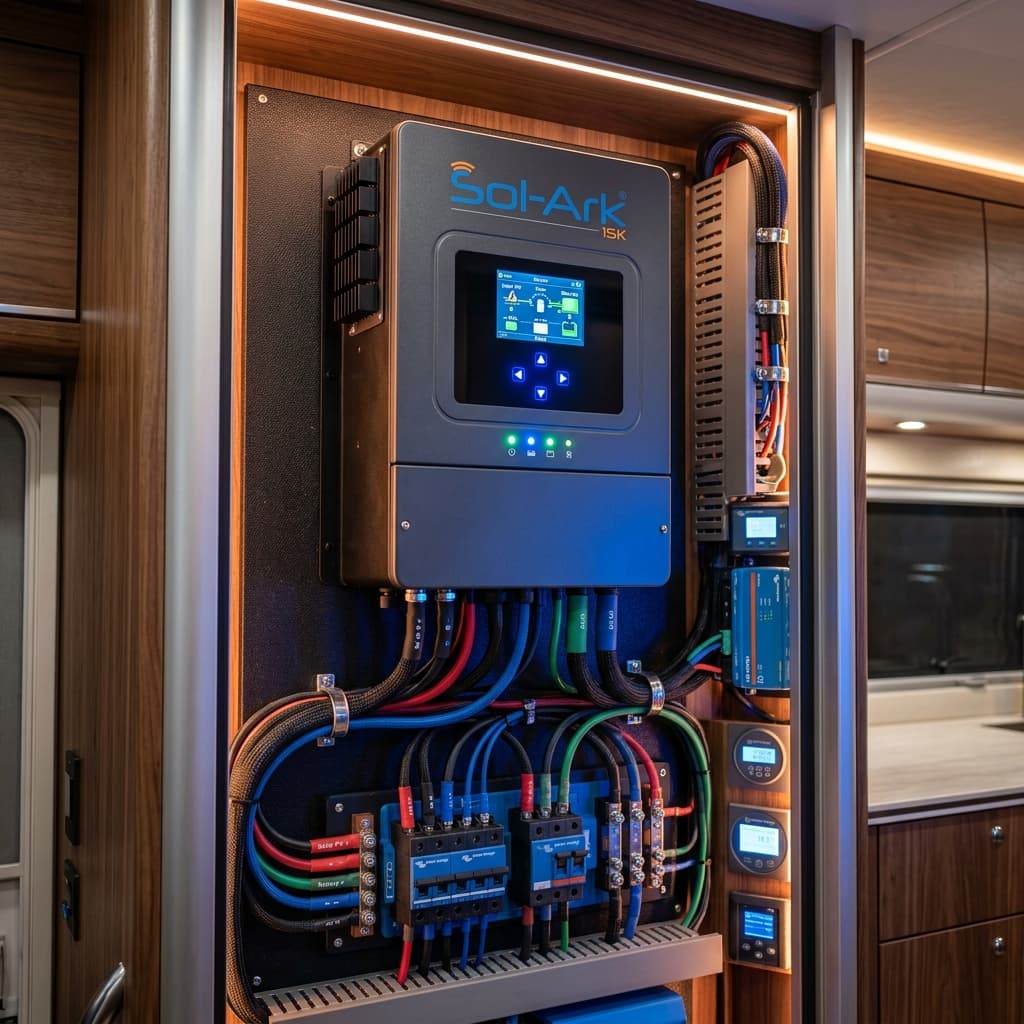
Sol Ark 15K fire - manufacturer blaming the clipping current limit
This article presents a comprehensive analysis of a large-scale numerical sequence, ranging from 0.5 to over 101,000, revealing hidden patterns, periodic fluctuations, and outlier values. Key findings include recurring clusters (e.g., 229-230-230-231), gradual increments followed by sharp jumps, and potential data anomalies. Researchers in data science, statistics, and pattern recognition will find value in the methodologies for sequence segmentation and trend detection. The study also discusses implications for time-series forecasting and anomaly identification. Keywords: numerical sequence analysis, pattern recognition, anomaly detection, time series data, statistical trends.
Read Full Guide
EcoFlow Delta Pro Ultra 2 vs Bluetti EP900: 10kWh Off-Grid Kings
Stop building DIY systems. This is the ultimate showdown between the monumental EcoFlow Delta Pro Ultra 2 and the Bluetti EP900 10kWh All-In-One energy storage titans for large scale RVs.
Read Full Guide
BougeRV 300W N-Type: Is This the Most Efficient RV Solar Panel of 2026?
N-Type technology has finally come to the 300W segment. We tested the BougeRV 300W N-Type against standard PERC panels to see if the 23%+ efficiency claim holds up under real RV conditions.
Read Full Guide